
1. Pengenalan
This manual provides essential instructions for the safe and efficient use of your EF ECOFLOW 125W Bifacial Modular Solar Panel (4-Pack). Please read this manual thoroughly before operating the product and retain it for future reference. These solar panels are designed to convert sunlight into electrical energy, suitable for various applications including camping, RVs, and home backup systems.
2. Arahan Keselamatan
- Do not attempt to disassemble, repair, or modify the solar panel. Incorrect assembly can lead to fire or electric shock.
- Keep the solar panel away from fire and direct heat sources.
- Avoid exposing the solar panel to corrosive substances.
- Jangan rendam panel solar dalam air atau cecair lain.
- Handle the panels with care. The glass surface is durable but can break if subjected to severe impact.
- Ensure all connections are secure and correct before operation.
- When deploying outdoors, secure the panels to prevent them from being blown over by wind.
- Avoid touching the panel surface when it is hot.
3. Kandungan Pakej
Sahkan bahawa semua item terdapat dalam pakej anda:
- EF ECOFLOW 125W Bifacial Modular Solar Panel x 4
- XT60W to XT60i Extension Charging Cable x 1
- XT60W to Solar Connector Extension Cable (MC4 Compatible) x 1
- Solar Extension Cable (6.56 feet/ 2M) x 1
- Solar Connector to XT60i Extension Cable (MC4 Compatible) x 1
- Beg Pelindung
- Panduan Mula Pantas
- Safety Instructions & Warranty Card
4. Ciri-ciri Produk
4.1 High Efficiency Solar Cells
The panels utilize N-Type TOPCon solar cell technology, offering up to 25% conversion efficiency. The dual-sided design captures additional solar energy from reflected light, potentially generating up to 138W output per panel under optimal conditions. These cells perform well in overcast conditions and maintain high energy conversion at elevated temperatures, with a projected lifespan of up to 30 years with 90% output.

Image: EF ECOFLOW 125W Bifacial Modular Solar Panels deployed with their integrated stands, ready for solar energy capture.

Image: The dual-sided design of the solar panel is shown, demonstrating how it captures additional solar energy from reflected light, with examples of power gain percentages over different ground surfaces.
4.2 Reka Bentuk Modular
The innovative modular design allows for flexible power configurations. Panels can be connected in parallel using XT60W connectors, supporting up to 8 panels (1000W total) or more complex series/parallel setups for higher wattage systems. This design facilitates seamless expansion within safe operating ranges.
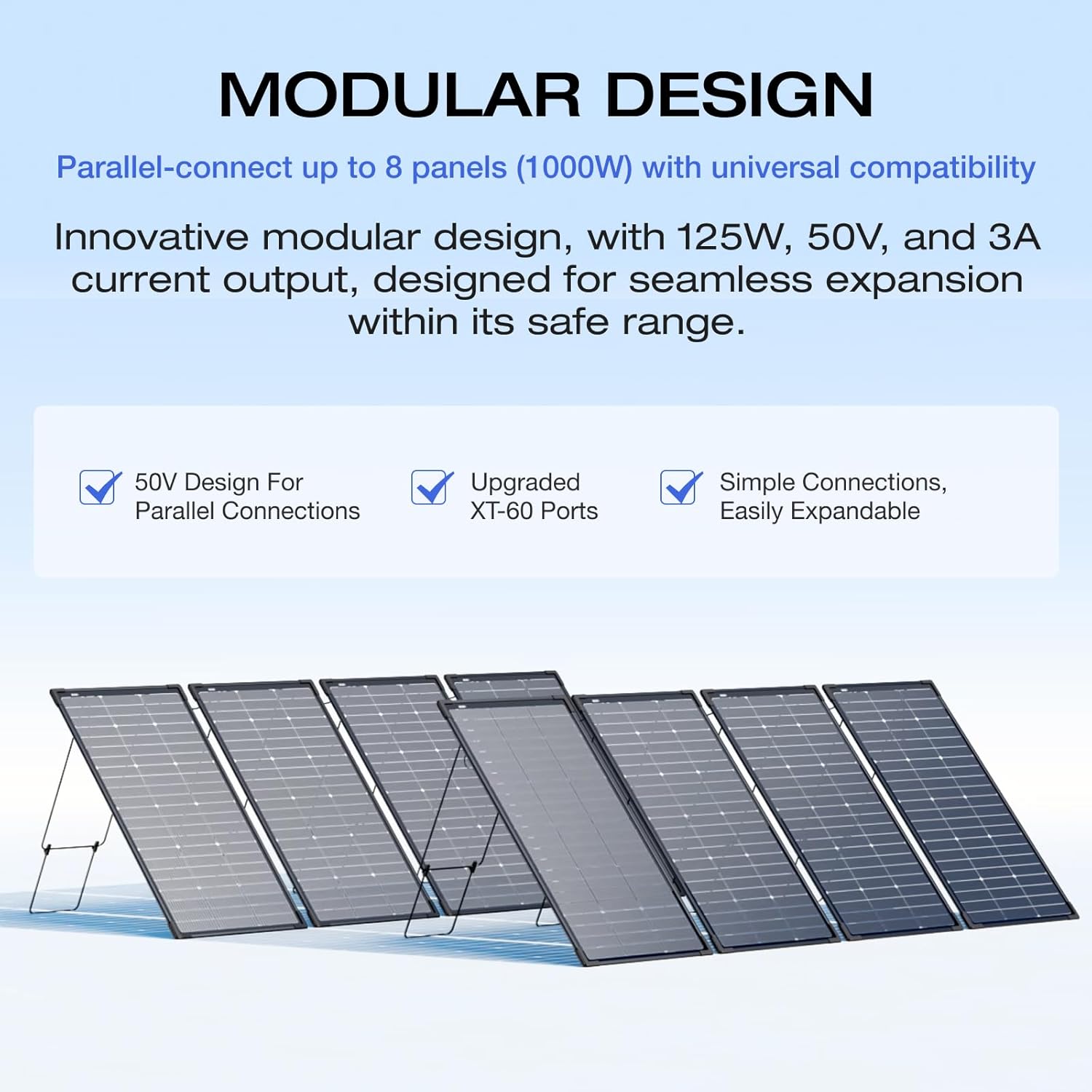
Image: This image highlights the modular design, showing how multiple 125W panels can be connected in parallel for increased power output, featuring 50V design, upgraded XT-60 ports, and simple, expandable connections.
4.3 Adjustable Support and Solar Angle Guide
Each panel includes an integrated adjustable support system, allowing for angle adjustments between 30-60 degrees to optimize solar generation. A built-in solar angle guide assists in positioning the panel at the ideal 90-degree angle to the sun for maximum energy capture.

Image: This image illustrates the adjustable support bracket, allowing for 30-60 degree angle adjustments, and highlights the integrated solar angle guide for precise panel positioning to maximize sunlight capture.
4.4 Durable, All-Weather Design
Constructed with a robust anti-corrosive aluminum frame, 1 mm ultra-thin tempered glass, POE films for UV and moisture resistance, and PET backsheets, these panels are designed for long-lasting outdoor performance. They feature an IP68 waterproof rating and a waterproof XT60-W connector, ensuring reliability in various weather conditions.

Image: Two close-up images demonstrate the panel's robust construction, with one showing its durable frame and the other illustrating its IP68 waterproof rating with water splashing on the surface.

Image: This diagram shows the internal layers of the solar panel, including 1.1 mm ultra-thin tempered glass, POE film, N-type TOPCon cell, and PET backsheet, contributing to its durability.
4.5 Flexible & Lightweight
Each 125W solar panel weighs approximately 9.26 lb (4.2 kg), making the 4-panel set (37 lb / 16.78 kg) significantly lighter than many rigid panels of comparable total wattage. The lightweight and modular nature enhance portability and ease of setup, especially for mobile applications.
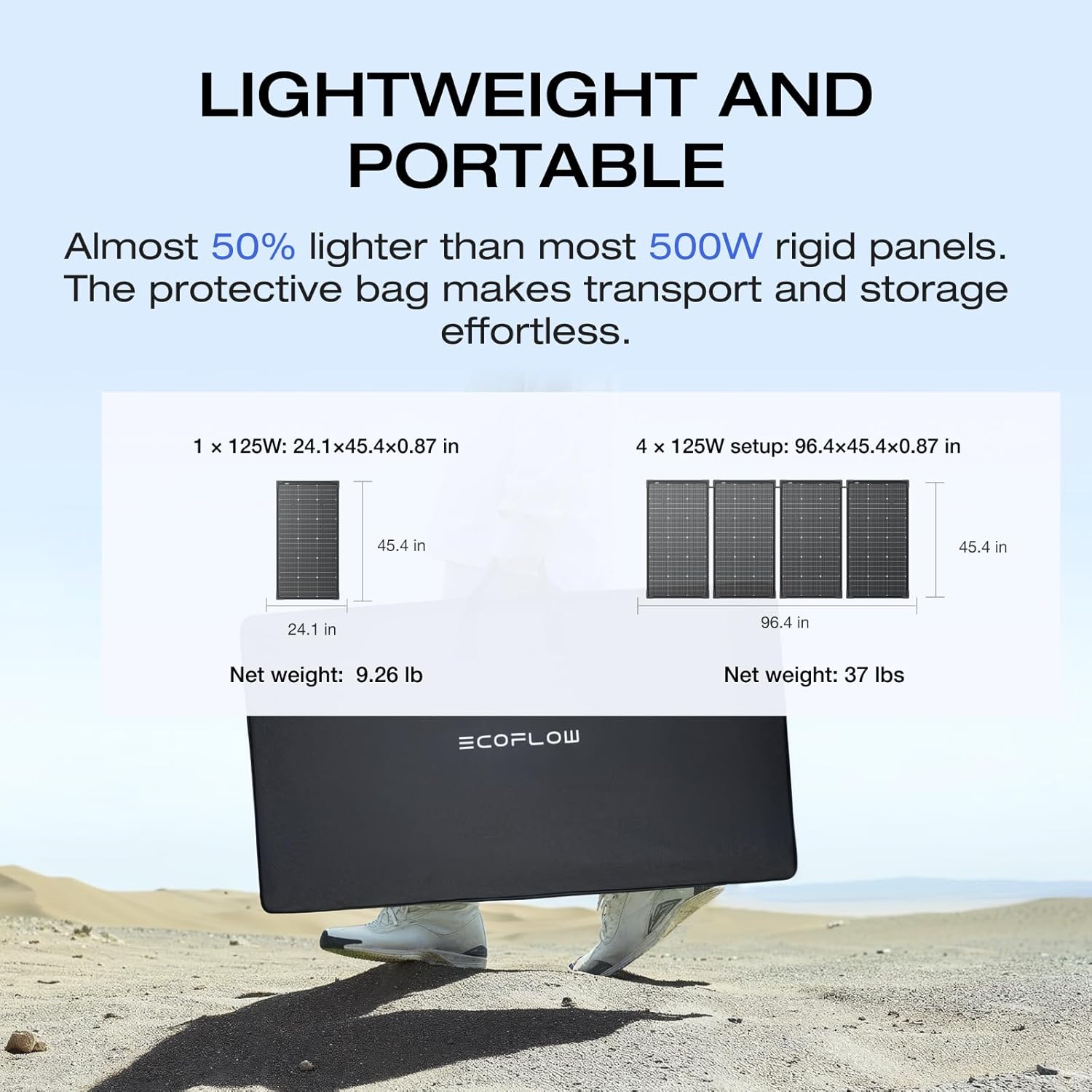
Image: This image displays the dimensions and net weight for a single 125W solar panel and the combined weight for a 4 x 125W setup, emphasizing its lightweight and portable design.
4.6 Plug and Play Connectivity
The panels are designed for easy integration with various power systems. They include photovoltaic connectors (MC4 compatible) and XT60 connectors, featuring waterproof, touch-safe, and anti-leak technology for reliable performance with EcoFlow power stations and third-party solar systems.

Image: Four EF ECOFLOW 125W solar panels are shown connected to an EcoFlow power station, demonstrating the charging process and plug-and-play connectivity.
5. Arahan Persediaan
5.1 Membongkar dan Pemeriksaan
- Carefully remove the solar panels and accessories from their packaging.
- Inspect each panel for any signs of damage during transit. If damage is found, contact customer support immediately.
- Confirm all listed package contents are present.
5.2 Panel Deployment
- Choose a location with maximum direct sunlight exposure, free from shadows.
- Unfold the integrated adjustable support legs on the back of each solar panel.
- Adjust the angle of the support legs to position the panel between 30-60 degrees relative to the ground.
- Use the integrated solar angle guide to fine-tune the panel's orientation, aiming for a 90-degree angle to the sun's rays for optimal performance.
- For outdoor use, especially in windy conditions, place weights (e.g., sandbags) on the support legs or secure the panels to prevent them from being moved or damaged by wind.
Image: This image illustrates the adjustable support bracket and solar angle guide for precise panel positioning during deployment.
5.3 Interconnecting Panels
The 125W solar panels are designed for parallel connection using their XT60W connectors. For connecting multiple panels:
- Connect the XT60W output of one panel to the XT60W input of another panel using the provided XT60W to XT60i Extension Charging Cable.
- Repeat this process for all panels you wish to connect in parallel.
- To connect the solar array to a power station or system, use the appropriate adapter cable (e.g., XT60W to Solar Connector Extension Cable for MC4 compatible systems, or Solar Connector to XT60i Extension Cable).
- Ensure all connections are firm and secure to prevent power loss or damage.
Image: This image illustrates the modular design and connection points for linking multiple solar panels in a parallel configuration.
6. Arahan Operasi
6.1 Connecting to a Power Station
- Once the solar panels are deployed and interconnected, connect the final output cable from the solar array to the solar input port of your compatible power station (e.g., EcoFlow DELTA or RIVER series).
- Ensure the power station is turned on and ready to receive solar input.
- The power station's display should indicate that it is receiving solar power and charging.
Image: Four EF ECOFLOW 125W solar panels connected to an EcoFlow power station, demonstrating the charging process.
6.2 Monitoring Power Output
Regularly check the power station's display or companion app (if available) to monitor the real-time power input from the solar panels. This helps in verifying optimal panel positioning and performance.
6.3 Petua Penggunaan Harian
- Pelarasan Sudut: Re-adjust the panel angle throughout the day to follow the sun's path for maximum energy capture.
- Shadow Avoidance: Ensure no shadows fall on the panels, as even partial shading can significantly reduce efficiency.
- Surface Reflection: Placing panels over reflective surfaces (e.g., light-colored ground, snow) can enhance the bifacial gain.
7. Penyelenggaraan
7.1 Pembersihan
- Regularly clean the surface of the solar panels to remove dust, dirt, leaves, or other debris that may obstruct sunlight.
- Use a soft cloth and mild, non-abrasive cleaning solution with water. Avoid harsh chemicals.
- Clean when the panels are cool, typically in the morning or late afternoon, to prevent thermal shock or rapid drying of cleaning agents.
7.2 Pemeriksaan
- Periodically inspect the panels for any physical damage, such as cracks in the glass, bent frames, or damaged cables/connectors.
- Check all cable connections for tightness and signs of wear or corrosion.
7.3 Penyimpanan
- When not in use, fold the panels and store them in their protective bag.
- Simpan di tempat yang sejuk dan kering, jauh dari cahaya matahari langsung dan suhu yang melampau.
- Ensure panels are clean and dry before storing.
8. Penyelesaian masalah
| Masalah | Kemungkinan Punca | Penyelesaian |
|---|---|---|
| No power output or low power output |
|
|
| Panels blow over in wind |
|
|
| Power station not recognizing solar input |
|
|
9. Spesifikasi
| Atribut | Perincian |
|---|---|
| Jenama | EF ECOFLOW |
| Nombor Model | EFSOLAR125W-4 |
| Kuasa Maksimum (setiap panel) | 125W (up to 138W bifacial output) |
| Maximum Power (4 panels) | 500W |
| Kecekapan | Sehingga 25% |
| Product Dimensions (single panel) | 115.3L x 2.2W x 61.2H sentimeter |
| Item Weight (single panel) | 9.26 lb (4.2 kg) |
| Item Weight (4 panels) | 37 lb (16.78 kg) |
| Kadar Kalis Air | IP68 |
| Jenis Penyambung | XT60W (MC4 Compatible) |
| Jenis Sel | N-Type TOPCon |
10. Waranti dan Sokongan
For warranty information, please refer to the 'Safety Instructions & Warranty Card' included in your package. For technical support, product inquiries, or to report issues, please contact EF ECOFLOW customer service through their official website or the contact information provided in the warranty card.
You can also visit the official EF ECOFLOW store for additional resources and product information: EF ECOFLOW Store