
1. Pengenalan
This manual provides detailed instructions for the safe and effective operation of the RuoShui Handheld LCR Meter 4080. This digital bridge multimeter is designed for precise measurement of inductance (L), capacitance (C), and resistance (R) across various test frequencies. It is an essential tool for engineers, technicians, and hobbyists working with electronic components.
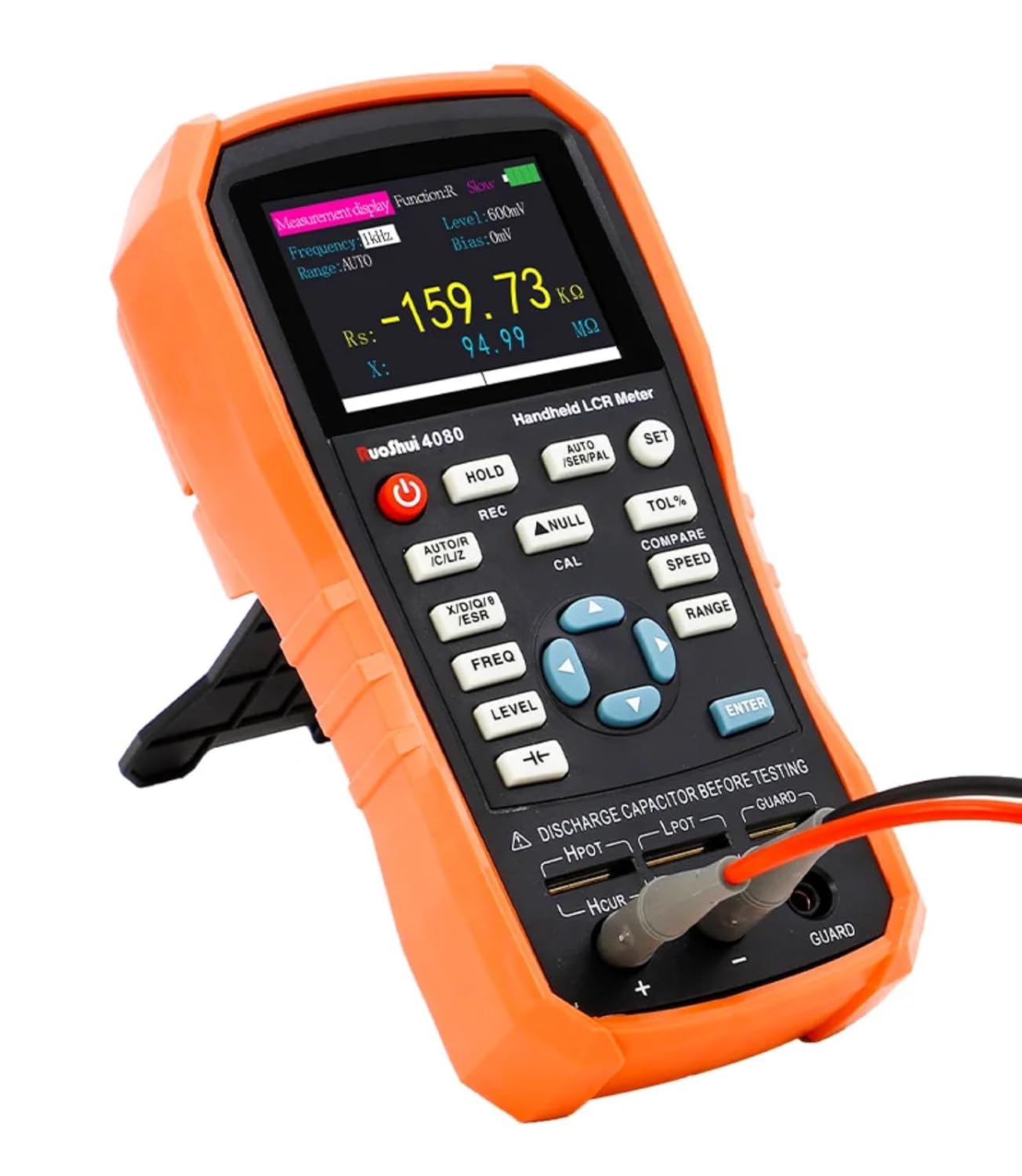
Figure 1: RuoShui Handheld LCR Meter 4080 with test leads connected.
2. Maklumat Keselamatan
Please read and understand all safety warnings and operating instructions before using this instrument. Failure to do so may result in injury or damage to the meter.
- Jangan gunakan voltage to the input terminals. This device is designed for passive component testing only.
- Always discharge capacitors before testing to prevent damage to the meter and ensure accurate readings.
- Pastikan kabel ujian berada dalam keadaan baik dan disambungkan dengan betul.
- Do not operate the meter in wet environments or near flammable gases.
- If the meter is damaged or malfunctioning, discontinue use immediately and contact support.
- Only use the specified battery type and charging method.
3. Produk Lebihview
3.1 Ciri-ciri Utama
- Measurement Capability: Inductance, Capacitance, Resistance, ESR, D, Q, Theta.
- Test Frequencies: 100Hz, 120Hz, 1KHz, 10KHz, 40KHz, 100KHz.
- Ketepatan: 0.2%.
- paparan: 2.8-inch TFT color display with backlight.
- Ketersambungan: Mini-USB for PC communication and data acquisition.
- Kuasa: Internal Lithium Polymer battery, USB-C charging.
- Measurement Speeds: Fast (4 times/s), Medium (2 times/s), Slow (1 time/s).
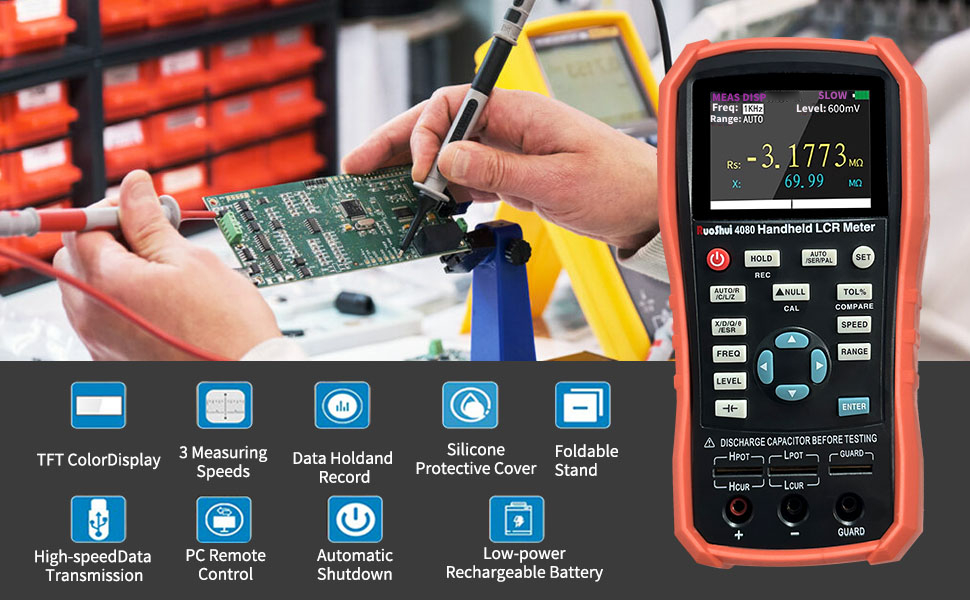
Gambar 2: Lebihview of the RuoShui 4080 LCR Meter's key features including TFT color display, multiple measuring speeds, data hold, silicone protective cover, foldable stand, USB data transmission, PC remote control, automatic shutdown, and low-power rechargeable battery.
3.2 Meter Layout and Controls
Familiarize yourself with the meter's physical components and controls as shown in Figure 3.

Figure 3: Labeled diagram of the RuoShui 4080 LCR Meter's display, buttons, and test terminals.
- Skrin Paparan: 2.8-inch TFT color display for measurement readings and settings.
- Butang Kuasa: Menghidupkan/mematikan peranti.
- Butang TAHAN: Freezes the current measurement on the screen. A long press shows min/max/average values.
- AUTO/R/C/L/Z Button: Selects the main measurement parameter (Auto, Resistance, Capacitance, Inductance, or Impedance).
- Butang REC: Mengaktifkan mod rakaman data.
- NULL/CAL Button: Offsets displayed values (short press). Initiates calibration procedure (long press).
- X/D/Q/ESR Button: Selects secondary measurement parameters (Reactance, Dissipation Factor, Quality Factor, ESR).
- FREQ Button: Cycles through test frequencies (100Hz, 120Hz, 1KHz, 10KHz, 40KHz, 100KHz).
- Butang ARAS: Adjusts the test signal level (300mV, 600mV, 1000mV).
- Bias Voltage Butang: (Indicated by a specific symbol, often a capacitor with a DC line) Applies a DC bias voltage (0V, 100mV, 300mV, 600mV).
- Direction Keys (Up/Down/Left/Right): Navigasi menu dan laraskan tetapan.
- Butang ENTER: Mengesahkan pilihan dalam menu.
- Butang SET: Accesses system settings (Language, Auto-off, Brightness, Beep, Colors, PowerOn).
- AUTO/SER/PAL Button: Toggles between Auto, Series, and Parallel equivalent circuit modes.
- TOL% Button: Activates tolerance comparison mode.
- COMPARE Button: Used in conjunction with TOL% for component sorting.
- Butang SPEED: Selects measurement speed (Fast, Medium, Slow).
- Butang RANGE: Selects measurement range (Auto or manual).
- Five-terminal Test Slot: For direct insertion of components.
- Three-terminal Test Jacks: For connecting test leads (Hpot, Lpot, Hcur, Lcur, Guard).
- Port USB Mini: For charging and PC communication.
4. Persediaan
4.1 Mengecas Bateri
The LCR Meter 4080 is powered by an internal Lithium Polymer battery. Before first use, or when the battery indicator is low, charge the device using the provided Mini-USB cable and a compatible USB power adapter (not included). The screen will display "In Charging" and the battery level icon during charging. The meter can be used while charging.

Rajah 4: Sisi view of the RuoShui 4080 LCR Meter showing the Mini-USB charging port.
4.2 Menghubungkan Petunjuk Ujian
For most measurements, use the provided alligator clip test leads. Connect the leads to the three-terminal test jacks at the bottom of the meter. Ensure a secure connection for accurate readings.
- Connect the red lead to the Hpot dan Hcur terminals (often combined).
- Connect the black lead to the Lpot dan Lcur terminals (often combined).
- The PENGAWAL terminal can be used for shielded measurements to reduce external interference.
Alternatively, small components can be inserted directly into the five-terminal test slot for quick measurements. This slot is designed for 4-wire measurement, with the drive on the bottom metal lip and sense on the top metal lip.
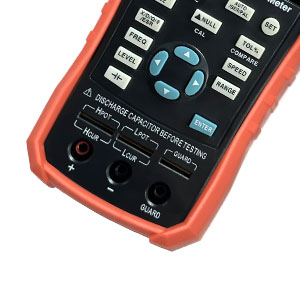
Rajah 5: Jarak dekat view of the five-terminal test slot and three-terminal test jacks.
5. Arahan Operasi
5.1 Hidupkan/Mati Kuasa
Tekan dan tahan butang Butang Kuasa (red circle with line) to turn the meter on or off.
5.2 Basic Measurements (L/C/R)
- Sambungkan Komponen: Connect the component to be tested using the test leads or insert it into the direct test slot. Remember to discharge capacitors first.
- Select Main Parameter: Tekan ke AUTO/R/C/L/Z button to cycle through automatic detection (AUTO), Resistance (R), Capacitance (C), Inductance (L), or Impedance (Z). In AUTO mode, the meter attempts to identify the component type.
- Select Test Frequency: Tekan ke FREQ button to choose the desired test frequency (100Hz, 120Hz, 1KHz, 10KHz, 40KHz, 100KHz). The chosen frequency will be displayed on the screen.
- Select Measurement Speed: Tekan ke LAJU button to select Fast, Medium, or Slow measurement speed. Slower speeds generally provide more stable readings.
- Baca Pengukuran: The primary measurement (L, C, or R) will be displayed prominently on the screen.
Figure 6: Close-up of the LCR Meter's display showing measurement readings.
5.3 Equivalent Circuit Modes (Series/Parallel)
Tekan ke AUTO/SER/PAL button to switch between Auto, Series, and Parallel equivalent circuit modes. The appropriate mode depends on the component and test frequency:
- Mod Siri: Often preferred for low impedance components (e.g., small inductors, large capacitors).
- Mod Selari: Often preferred for high impedance components (e.g., large inductors, small capacitors, resistors).
- Mod Auto: The meter attempts to select the most suitable mode.
5.4 Calibration (Open/Short Correction)
Calibration helps to remove residual impedance from test leads and fixtures, improving measurement accuracy. It is recommended to perform calibration when changing test leads or frequently for critical measurements.
- Short Calibration:
- Connect the provided shorting bar to the test terminals or short the test leads together.
- Tekan lama NULL/CAL button. The screen will indicate "Short" calibration in progress and show a countdown. This process takes approximately 45 seconds.
- Open Calibration:
- Remove the shorting bar or ensure the test leads are open (not touching anything).
- Tekan lama NULL/CAL button again. The screen will indicate "Open" calibration in progress and show a countdown. This process also takes approximately 45 seconds.
The meter automatically senses the presence or absence of the shorting bar, allowing calibration in either order. Calibration settings can be preserved through power cycles if "PowerOn: Last" is selected in the system settings.
5.5 Secondary Measurement Parameters (ESR, D, Q, X)
Tekan ke X/D/Q/ESR button to cycle through secondary measurement parameters displayed below the main reading:
- ESR (Equivalent Series Resistance): Important for evaluating capacitor quality.
- D (Dissipation Factor): Indicates the energy loss in a component.
- Q (Quality Factor): The inverse of the dissipation factor, indicating the efficiency of a reactive component.
- X (Reactance): The imaginary part of impedance.
5.6 Test Signal Level and Bias Voltage
- Test Level: Tekan ke TINGKAT button to adjust the RMS test voltage (300mV, 600mV, 1000mV). A higher level can improve signal-to-noise ratio (SNR) for better accuracy, especially for low-value components.
- Bias Voltage: Gunakan yang berdedikasi Bias Voltage Butang (or navigate via arrow keys) to apply a DC bias (0V, 100mV, 300mV, 600mV). This is useful for testing electrolytic capacitors or semiconductors.
5.7 Special Function for Electrolytic Capacitors
The meter includes a dedicated function for electrolytic capacitors. Activating this function typically sets the test level to a fixed 600mV RMS and applies a 1V offset, ensuring the lowest part of the test sine wave remains above ground. Refer to the meter's on-screen prompts or specific button for this function.
5.8 Tetapan Sistem
Tekan ke SET button to access system settings. Use the Kekunci Arah to navigate and adjust options:
- Bahasa: Select Chinese or English.
- AutoMati: Set automatic power-off time (OFF, 5, 15, 30, 60 minutes).
- terang: Adjust backlight brightness in 20% increments.
- Kuasa: Choose whether the meter starts with the last settings ("Last") or default settings ("Default").
- Bunyi: Configure audible alerts (Off, Key+Notice, Only Notice).
- warna: Select display color scheme (White, Yellow, Cyan, Coral).
6. Remote Communication
The RuoShui 4080 LCR Meter supports remote communication and data acquisition via its Mini-USB port. Connect the meter to a PC using a Mini-USB cable. You may need to install specific driver software provided by RuoShui for your operating system to enable communication. This feature allows for remote control of the meter and logging of measurement data.

Figure 7: The LCR Meter connected to a PC for remote communication and data display.
7. Penyelenggaraan
7.1 Pembersihan
Lap bahagian luar meter dengan kain lembutamp cloth. Do not use abrasive cleaners or solvents. Ensure no moisture enters the device.
7.2 Penyimpanan
Store the meter in a cool, dry place away from direct sunlight and extreme temperatures. If storing for extended periods, ensure the battery is partially charged (around 50%) to prolong its lifespan.
7.3 Perlindungan Skrin
The screen may come with a protective film. Carefully remove this film for optimal display clarity. Use a soft cloth to clean the screen.
8. Penyelesaian masalah
| Masalah | Kemungkinan Punca | Penyelesaian |
|---|---|---|
| Meter tidak dihidupkan. | Bateri lemah atau habis. | Charge the battery using the Mini-USB cable. |
| Inaccurate or unstable readings. |
|
|
| Meter freezes or becomes unresponsive. | Software glitch or unexpected input. | Press and hold the power button to force a restart. If persistent, disconnect the battery (if accessible) or contact support. |
| PC communication not working. | Pemacu yang hilang atau salah. | Ensure the correct drivers for the RuoShui 4080 LCR Meter are installed on your PC. Check cable connection. |
9. Spesifikasi
| Parameter | Nilai |
|---|---|
| Model | HT-LCR Meter-4080 |
| Measurement Frequencies | 100Hz, 120Hz, 1KHz, 10KHz, 40KHz, 100KHz |
| Julat Pengukuran | L: 0-1000H, C: 0-20mF, R: 0-20MΩ |
| Parameter Utama | L, C, R, Z |
| Sub Parameter | X, D, Q, ESR |
| Kaedah Setara | Sambungan siri dan selari |
| Range Method | Manual, automatic |
| Uji Kelajuan | Fast (4 times/s), Medium (2 times/s), Slow (1 time/s) |
| Test End Configuration | Three end and five end |
| Ciri-ciri Standard | Short circuit, open circuit correction |
| Antaramuka Komunikasi | Mini USB (Virtual Serial Port) |
| Test Signal Level | 0.3Vrms/0.6Vrms optional (Note: Product description mentions 300mV, 600mV, 1000mV) |
| Impedans Keluaran | 100Ω |
| Ketepatan Maksimum | 0.20% |
| Electrolytic Capacitor Mode | ya |
| DCR Mode | ya |
| Bias Dalaman | ya |
| Pengekalan Data | ya |
| Rekod Data | ya |
| Sumber Kuasa | 5V, 2600mAh Lithium Polymer battery (included) or Mini USB power supply |
| Skrin Paparan | Skrin paparan LCD TFT 2.8 inci |
| Saiz Badan | 190 * 90 * 50mm (7.48 x 3.54 x 1.97 inches) |
| Berat Badan | 423g (0.93 lbs) |
Catatan: Spesifikasi boleh berubah tanpa notis.
10. Waranti dan Sokongan
For warranty information and technical support, please refer to the documentation included with your purchase or contact RuoShui customer service directly. Contact details can typically be found on the manufacturer's official webtapak atau melalui tempat pembelian anda.
Pengeluar: RuoShui
Nombor Model: HT-LCR Meter-4080